Wednesday, January 26, 2011

Race to Nowhere (taken from Dangerously Irrelevant)

I really liked Race to Nowhere

Last September I blogged the trailer for the movie, Race to Nowhere, which focuses on the achievement pressures faced by many of our schoolchildren. Today I had an opportunity to attend a screening of the full movie. Here are 30 quotes from the film. Some of these might not be word-for-word but they’re close; I was paying attention to the movie, not my typing. I’ve highlighted my 8 favorites from the list below…

  1. RacetonowhereI can’t really remember the last time I just went outside and ran around
  2. We do whatever it takes to get an A
  3. When I had kids, I didn’t think that the only time I’d see them was for 20 minutes at dinner
  4. These kids are so overscheduled and tired … I’m afraid that our children are going to sue us for stealing their childhoods
  5. We want the best for them [so] we put pressure on them to be what we want them to be
  6. [All of this pressure] ends up turning kids into little professionals
  7. I figured out that not eating gave me more energy … but it still wasn’t enough to get everything done
  8. My school principal told me [when I tried to return from a treatment facility for anorexia and anxiety] that she didn’t want the teachers to have to worry about me – I was too much of a distraction for them [and other students]
  9. We lose boys because they tune out and we lose girls to depression
  10. The countries that outperform us on international tests actually give less homework than we do in the United States
  11. At what point did it become okay for schools to dictate how we spend our lives after the bell rings? [regarding homework]
  12. Parents need to educate themselves that homework isn’t going to make their students any smarter
  13. When American kids encounter questions [on international assessments that don’t look like what they’re used to from their rote practice], they fall apart
  14. These tests that they do so horrible on - they don’t test my kids on the curriculum, they test them on their culture and their culture isn’t represented on the tests
  15. I tell my [urban] students that learning is power – to do whatever you want to do in life, you have to be a learner and you have to care – that is not what the district wants from me as a teacher
  16. If we forget this [question] or do a different one, then we’re going to get in trouble and we’ll lose 5 minutes of recess [4th grader]
  17. Your 6–month-old is supposed to be sucking on his toes and thumbs, not doing flashcards
  18. [Students say] ‘The teacher doesn’t care – it’s just busy work - why CAN’T I just copy my homework?’
  19. The point of education is to learn, not memorize
  20. It’s impossible to cover all of the material for the AP course in one year. Literally impossible.
  21. After my daughter passed her AP French exam, she said, “I never have to speak French again.”
  22. So much of [kids’] time is structured. The only unstructured time they seem to have is the time they spend on the computer.
  23. What’s happening these days is that kids aren’t getting a chance to find out what they love to do.
  24. They’re 4 or 8 [years old] and they’re resume-building
  25. Parents say ‘My child is a good kid.’ No, they were a good performer. You never found out if they were a good kid. You just know they’re a good student, not a good solid kid.
  26. I stopped trying because if you don’t try, you can’t fail.
  27. I think that success in America is measured by how much money you make, not how happy you are in your life
  28. The environment and culture are so competitive that kids don’t feel like they can ever let people see their true selves
  29. If you’ve always had As, there’s only one way to go and that’s down, so that B feels like a failure
  30. We need to redefine success for kids … We have to get off this treadmill together. [We have to discuss] what does it take to create a happy, motivated, creative human being?

Discussion afterward

Here are a few statements afterward from the international educators and others who watched the film:

  1. None of us went into education to inflict harm on children but when you put it all together the net effect is often much different.
  2. At my previous school we eliminated homework and instead gave families a booklet called ‘Supporting Learning’ that gave them ideas of things they could do at home with their kids instead.
  3. How many of you assign homework? How would you handle a parent that asked if their child could opt out of the homework you assign? [this question was mine]
  4. Five to seven hours a day at school are plenty of time to do what we need to do academically with students
  5. Many of your parents have dedicated much of their lives to preparing students for Harvard (a process Alfie Kohn calls ‘Preparation H’). How do you handle it when as educators you’re trying to slow down, reduce workload, stop the ‘race to nowhere,’ etc. for kids but parents aren’t buying what you’re selling? [this question was mine]
  6. We have a responsibility to assuage the collective anxiety that we feel about ‘doing well.’

The film is about an hour long. Although it’s targeting what are in many ways polar opposite issues and demographics compared to Waiting for Superman, the film is well worth a watch. I greatly appreciated the opportunity to finally see it.

Closing thoughts

My children are 13, 10, and 6; so far they have been ‘excellent students.’ They live in a college town community and attend schools in which there is a lot of academic pressure on students - from parents, from other kids’ parents, from educators, from student peer groups, from society in general, etc. How much of that is being internalized by my children despite the messages that we try to send at home? Although my wife and I repeatedly discuss with our kids that learning is supposed to be a joyful experience – that we’d much rather that they love what and how they’re learning and have a chance to pursue their interests than get good grades – I still worry about what messages they’re incorporating into their mental models of success. It’s an ongoing conversation and battle and I’m not completely certain that we’re winning. I’m also uncertain if the fact that I’m a workaholic – albeit on things for which I’m usually interested and passionate – helps or hinders my cause with my kids.

I’ve recommended to my school district leadership team (administrators and school board) that they do a screening of this film for local parents. They’ve shown no interest to date, which is unfortunate because this film is extremely relevant for our community and our families.

I try to remember to ask my kids daily if they have a happy life. I hope they’ll always be honest with me.

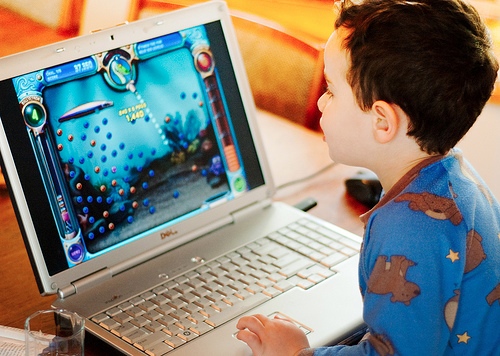
Technology at an Early Age????

Panic! Children Are Learning to Use Technology at an Early Age!

There’s something about headlines stirring up fear and revulsion over children’s usage of technology that really annoys me. The latest story making the rounds: an AVG study (yes, that’s AVG the antivirus company, not AVG a child development research group) that finds children are learning to use computers before learning other “life skills.”

That distinction right there should probably give folks pause, as I’d contend, at least, that a familiarity with technology is surely becoming a “life skill” in its own right.

But the AVG study goes on to cite a number of activities that preschool age children aren’t doing, implying by way of contrast, that preschoolers are on computers instead. (Gasp!)

“Kids these days” can use a mouse before they can learn to tie their shoes or ride a bike. The latter insight is being bandied about as some sort of sign we’re raising a generation of square-eyed robots who never venture outside to play (unless of course, they can carry their iPads with them).

The AVG survey does contain some interesting data, don’t get me wrong. 25% of children age 2 to 5 can open a web browser. 44% of 2 to 3 year olds know how to play a computer game. European preschoolers are more apt than U.S. preschoolers to know how to make a cellphone call. At this age, there is no gender division between boys and girls in their technology skills.

What bothers me about the study, however, is how these online activities are juxtaposed to those offline. Playing a computer game versus being able to swim. Using a smart-phone app versus riding a bike. Making a cellphone call versus tying your shoes.

I’m suspicious, perhaps, because my “life skills” at age 2 to 5 only just included how to tie my shoes. And honestly, I think I might’ve been 6 before I learned how to ride my bike. So when AVG says that “small children today are more likely to navigate with a mouse, play a computer game and increasingly – operate a smart-phone – than swim, tie their shoelaces or make their own breakfast,” I laugh. I’m actually quite thrilled to think that a preschooler would have access to technology because, yes, when you’re 4, you’re pretty damn incompetent — you can’t ride your bike or wipe your butt or read. You might not be able to read yet. But you can play. And you can play with technology. If you learn at age 4 how to use a mouse, does that preclude your learning at age 4 1/2 to swim? Seriously?

I really don’t think these changing skills are cause for panic. If anything, they should serve as a reason to teach kids the same sorts of safety measures we’d demand they understand before they hopped on a bike or jumped into a swimming pool.

Tuesday, January 18, 2011

Resiliency...

To be resilient…

  1. Focus on results. Embrace the fact that results are what we’re all really after. Effort and attempts are great first steps, but we need to act with commitment to delivering (just like we want people to do for us).
  2. Make lessons of failures. Minimize the tendency to make a mistake anything more than a lesson on how not to do something. We need to learn from our experiences and accept them as tuition for future success. And yes… Our mistakes might put us in a bind at times and have some uncomfortable consequences but again, that’s real life.
  3. Continue on. Smarter.
  4. Reinforce. Support each other (and ourselves) by continually reminding and encouraging one another to deliver on the first three points.

Sunday, January 16, 2011

Vocabulary Sites


Some more useful sites for teaching, learning and practising vocabulary

Puzzlemaker at Discovery education enables teachers to create puzzles,

You can create flashcards using Flashcard maker from Scholastic.com

Spelling wizard is also a great tool to help self study or enables teachers to create spelling scramble and word search

At SuperKidsVocabulary Builders, you can easily create puzzles, wordsearch or play games and learn new words.

Vocabulary.com is a great site to learn and teach vocabulary.

OneLook Dictionary enables you to access definitions from different dictionaries.

Flickr related tag browser is great. You type the word you want to search and see flickr images and related other words and images too.

ClassTools.net is a wonderful site to create flashcards, games, diagrams, puzzles.

Vocabulary and Spelling City is another great site to play with words.

Related post on this blog: Teaching Vocabulary-links, books, ideas

Free Mathematics Tutorials, Problems and Worksheets

Great Resource

Mathematics Apps

Wolfram|Alpha Announces Music Theory, Algebra & Calculus Apps for the iPad

Written by Andy Brovey

Topics: News

Wolfram|Alpha is the maker of Mathematica and more recently, Wolfram|Alpha apps for the iPad. The technology behind their products is designed to accept free-form input and serve as a knowledge and computational engine to produce and present results. They recently announced a series of Course Assistant Apps for Algebra, Calculus and Music Theory. The Algebra and Music Theory apps are $1.99 each and the Calculus app is $2.99. More here.

Monday, December 13, 2010

21 Things That Will Become Obsolete in Education by 2020

Tuesday, December 15, 2009

21 Things That Will Become Obsolete in Education by 2020

Last night I read and posted the clip on '21 Things That Became Obsolete in the Last Decade'. Well, just for kicks, I put together my own list of '21 Things That Will Become Obsolete in Education by 2020'.

1. Desks
The 21st century does not fit neatly into rows. Neither should your students. Allow the network-based concepts of flow, collaboration, and dynamism help you rearrange your room for authentic 21st century learning.

2. Language Labs
Foreign language acquisition is only a smartphone away. Get rid of those clunky desktops and monitors and do something fun with that room.

3. Computers
Ok, so this is a trick answer. More precisely this one should read: 'Our concept of what a computer is'. Because computing is going mobile and over the next decade we're going to see the full fury of individualized computing via handhelds come to the fore. Can't wait.

4. Homework
The 21st century is a 24/7 environment. And the next decade is going to see the traditional temporal boundaries between home and school disappear. And despite whatever Secretary Duncan might say, we don't need kids to 'go to school' more; we need them to 'learn' more. And this will be done 24/7 and on the move (see #3).

5. The Role of Standardized Tests in College Admissions
The AP Exam is on its last legs. The SAT isn't far behind. Over the next ten years, we will see Digital Portfolios replace test scores as the #1 factor in college admissions.

6. Differentiated Instruction as the Sign of a Distinguished Teacher
The 21st century is customizable. In ten years, the teacher who hasn't yet figured out how to use tech to personalize learning will be the teacher out of a job. Differentiation won't make you 'distinguished'; it'll just be a natural part of your work.

7. Fear of Wikipedia
Wikipedia is the greatest democratizing force in the world right now. If you are afraid of letting your students peruse it, it's time you get over yourself.

8. Paperbacks
Books were nice. In ten years' time, all reading will be via digital means. And yes, I know, you like the 'feel' of paper. Well, in ten years' time you'll hardly tell the difference as 'paper' itself becomes digitized.

9. Attendance Offices
Bio scans. 'Nuff said.

10. Lockers.
A coat-check, maybe.

11. IT Departments
Ok, so this is another trick answer. More subtly put: IT Departments as we currently know them. Cloud computing and a decade's worth of increased wifi and satellite access will make some of the traditional roles of IT -- software, security, and connectivity -- a thing of the past. What will IT professionals do with all their free time? Innovate. Look to tech departments to instigate real change in the function of schools over the next twenty years.

12. Centralized Institutions
School buildings are going to become 'homebases' of learning, not the institutions where all learning happens. Buildings will get smaller and greener, student and teacher schedules will change to allow less people on campus at any one time, and more teachers and students will be going out into their communities to engage in experiential learning.

13. Organization of Educational Services by Grade
Education over the next ten years will become more individualized, leaving the bulk of grade-based learning in the past. Students will form peer groups by interest and these interest groups will petition for specialized learning. The structure of K-12 will be fundamentally altered.

14. Education School Classes that Fail to Integrate Social Technology
This is actually one that could occur over the next five years. Education Schools have to realize that if they are to remain relevant, they are going to have to demand that 21st century tech integration be modelled by the very professors who are supposed to be preparing our teachers.

15. Paid/Outsourced Professional Development
No one knows your school as well as you. With the power of a PLN in their backpockets, teachers will rise up to replace peripatetic professional development gurus as the source of schoolwide prof dev programs. This is already happening.

16. Current Curricular Norms
There is no reason why every student needs to take however many credits in the same course of study as every other student. The root of curricular change will be the shift in middle schools to a role as foundational content providers and high schools as places for specialized learning.

17. Parent-Teacher Conference Night
Ongoing parent-teacher relations in virtual reality will make parent-teacher conference nights seem quaint. Over the next ten years, parents and teachers will become closer than ever as a result of virtual communication opportunities. And parents will drive schools to become ever more tech integrated.

18. Typical Cafeteria Food
Nutrition information + handhelds + cost comparison = the end of $3.00 bowls of microwaved mac and cheese. At least, I so hope so.

19. Outsourced Graphic Design and Webmastering
You need a website/brochure/promo/etc.? Well, for goodness sake just let your kids do it. By the end of the decade -- in the best of schools -- they will be.

20. High School Algebra I
Within the decade, it will either become the norm to teach this course in middle school or we'll have finally woken up to the fact that there's no reason to give algebra weight over statistics and IT in high school for non-math majors (and they will have all taken it in middle school anyway).

21. Paper
In ten years' time, schools will decrease their paper consumption by no less than 90%. And the printing industry and the copier industry and the paper industry itself will either adjust or perish.