

Winners of the Christmas in April competition at the Armstrong Building...
Mrs. Work
Mrs. Korte
Mrs. Hansen #2
Mrs. Hansen #1
Mrs. Koop
A fashionable bunch of ladies!


"A simple question to ask is, "How has the world of a child changed in the last 150 years?" And the answer is, "It's hard to imagine any way in which it hasn't changed! But if you look at school today versus 100 years ago, it is more similar than dissimilar." -- Peter Senge, senior lecturer, Massachusetts Institute of Technology
What should learning in schools look like in the 21st Century? Are schools preparing students for success in a global society? These are two questions that quickly came to mind when reading the quote above from Peter Senge. It is essential more than ever that schools veer away from methodologies that worked for many years when we were educating a different type of student for a different role in society. Key to this transformation is the integration of authentic learning experiences and technology that engage students of all levels and make learning meaningful.
When I came to New Milford High School in 2004 there were many amazing programs in place. One was the Holocaust Study Tour. This global learning endeavor provides some of our students the opportunity to travel to Europe for at least 10 days and study the Holocaust in depth. This authentic learning experience cannot be reproduced in the classroom. For detailed information on the program please visit The New Milford Holocaust Project.
Technology now allows the students and staff at NMHS to share in the authentic learning experiences taking place in Europe (Germany, Poland, Czech Republic). Last year, we launched a blog where the students in Europe chronicled and reflected on essential questions, focusing on a dark time in human history. Meanwhile, students and staff back on the campus of NMHS are using the blog as a catalyst for a variety of other learning experiences. Some teachers even have their students respond to the posts each day. The first Holocaust Study Tour 2011 blog post should be up tomorrow so be sure to check it out.
Skype has also brought a whole new element to the program. Prior to the trip, students Skyped numerous times with their guide who resides in Israel. This year we even Skyped in a Holocaust survivor to our elective course on the topic. I use Skype to keep in contact with my teacher while on the trip and to sometimes converse with the students about what they are learning. We also encourage our history teachers to Skype with the study tour if the times can be worked out. At our District Open House this Thursday, I plan to Skype the group in from Europe to kick off the event. The theme for the event is appropriately centered around what it is like to be a student in the 21st Century.
It is an exciting time to be in education. Technology has really added a whole new dimension to learning. Schools that confine themselves to a bland curriculum, textbooks, worksheets, or learning activities that do not go beyond the walls of the brick and mortar building are really doing a disservice to their learners. In a society that is now globally connected through easy to use and cost effective web 2.0 tools, opportunities to engage and make the process of learning meaningful to all students has quickly become a reality. Teachers now have at their fingertips many tools to add a global context to any lesson.
For example, Skype in the Classroom is a free community that assists teachers in establishing connections between teachers in different countries to help their students learn. Unfortunately, many schools across the country block blogging tools and Skype as well as a variety of other web 2.0 technologies that foster creativity, collaboration, problem-solving, and communication skills. As Peter Block alluded to, schools have not evolved in step with societal changes. In order to best prepare out students, we must move away from an industrial model of instruction and let go of control in order to meet the diverse needs of today's learner. This will only happen when schools realize that technology is not the enemy and when combined with passionate teachers and visionary schools the end result for students is learning like never before.
How often have you heard the story of a school or district spending thousands of dollars on technology without any evidence it will have an impact on student learning?
Whether a failure to prepare teachers for a fundamental shift in how they teach or a failure to plan for technology obsolescence, district and school leaders have considerable information to gather and up-front planning to do if a laptop implementation is to be successful. One of the best ways to collect this information is to conduct a technology audit. It can save time, money and headaches.
Last year, I worked with a suburban school district that was preparing for a laptop initiative. Their initial thinking was to start small with just a few schools, then expand it K-12. The district leadership thought the high school would be the most logical starting point for the rollout.
After discussing the idea with principals, the superintendent decided to have McREL conduct a technology audit to see how comfortable teachers were with current technologies and how easily a new tool could be integrated into the current culture.
Classroom Climate
The audit results surprised them. Teachers of kindergarten through 2nd grade and those at the high school level tended to use the most traditional methods in their instruction. When I walked into these classrooms, students often were passive audiences to teacher-led, whole-group instruction. I saw a fair amount of worksheets and teacher-directed question-and-answer sessions.
This did not mean learning wasn’t happening, but a laptop initiative in this environment probably would have resulted in expensive machines being used for rudimentary tasks, such as early learning games or note taking.
At the upper-elementary and middle-school levels, however, instruction looked quite different. Students often were engaged in small-group, collaborative learning. The classrooms had a busy buzz to them as students discussed ideas, collaborated on projects and shared their learning with the larger group.
The structure of the rooms represented pods of activities. I often found the teacher taking the role of a facilitator who would help a group refocus or work through a challenge, then move on to the next group. The levels of Bloom’s taxonomy that the lessons targeted often were at a higher level of thinking. A set of laptops in this environment had potential to be used not only for building basic skills, note-taking and research, but also for collaboration and communication among groups and for evidence of learning beyond quizzes and tests.
Based on the audit details, the school district started the laptop initiative at the middle-school level, while focusing professional development on how to create engaging, project-based, differentiated classrooms.
Gathering Data
A good tech audit will gather data through various tools — surveys, focus groups, classroom walkthroughs, and interviews with members of the schools and district — to get an understanding of what learning looks like in that environment.
If you are considering implementing a 1:1 initiative, ask yourself these questions:
• How are the teachers and students in my building or district using the tools they already have?
• How well do my teachers vary how students are grouped?
• How well do my teachers allow flexibility and variety in showing evidence of learning? (Do students primarily show learning through a summative assessment, or do teachers use many formative assessments?)
• Do teachers support and extend students’ understanding of basic concepts by developing authentic projects that take student learning to a higher level?
• Do teachers know how technology can transform students’ capacity to create, collaborate and communicate?
• Do all students in the school or district emerge prepared to use 21st-century tools in collaborative and creative settings, or is their experience dependent upon teacher interest and comfort level?
• How ready are my teachers for highly differentiated instruction?
A Costly Tool
When schools and districts spend thousands of dollars on expensive and powerful equipment without finding out if their teachers and students are prepared to use these tools, they may find the machines are only being used, as Alan November points out in an article on his website November Learning , as a “$2,000 pencil” for web research, word processing, note taking and disseminating PowerPoint documents.
In these situations, teachers are, in a sense, integrating technology, but its use has little advantage over paper-and-pencil methods. Some teachers even may insist students put valuable learning tools away during instruction because they view them as distractions or inappropriate in the classroom.
On the other hand, when teachers are well-versed in creating environments in which students regularly collaborate on projects, use a variety of high-level strategies, and have choices in how they receive and disseminate what they have learned, technology seamlessly, almost invisibly, exists as a tool to facilitate these processes.
Which Route?
Implementing a 1:1 laptop initiative requires much more than purchasing hardware and software. It requires teachers being comfortable with no longer being the “sage on the stage.” It requires a general knowledge of various tools that help students collaborate on projects and communicate with others.
Finally, it requires a plan for dealing with inappropriate behavior in a way that addresses the infraction rather than banning the media that provided the means. A tech audit can help a school or district decide what professional development, curriculum alignment and staffing are needed for an initiative to be most successful.
Elizabeth Hubbell is an educational technology consultant at McREL in Denver, Colo. E-mail: ehubbell@mcrel.org
Social media is something that has become so prevalent in our culture that I have seen everything from large companies to churches having their own facebook accounts. When I first was presented with the idea that using Twitter, Facebook, or blogging as something in education I was weary of its application. As I have immersed myself in the process, and have seen my own staff and school use this themselves along with students, I have seen some tremendous changes in their practice.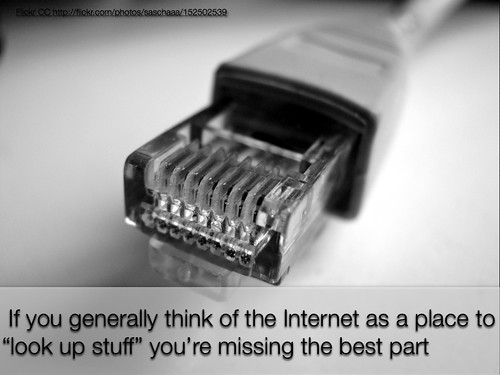
cc licensed flickr photo shared by shareski
I really believe that using technology just to do the same things that we have always done, but on the computer, is not a good enough reason. There has to be more. Thinking aboutthis today, I have really seen some of the impacts that social media is having on education.
1. It’s free. Okay, in reality, nothing is really free. We still have to pay for Internet and technology in our building, but our software costs have gone down significantly. As educators continuously have to deal with budget cuts, it is important that we use tools that do not have a cost on it. Safety is essential, but with teaching Internet safety, setting up certain sites, with a little hard work, the software costs nothing. Our school has paid $300 for server space (for three years) in the last two years that I have been here, and have set up a safe and secure blogging platform for our students. This is music to any educators’ (especially those dealing with budgets) ears.
2. It cuts down on isolation. One of our programs is an off-site building that is out in the country. This program serves 12 students and has two teachers. Every few years, this program is revisited and we ensure that teachers have an opportunity to move so that they have the ability to connectand learn from others. This year when we had the conversation, both teachers did not feel the need to move. They are both connected through many teachers through social networks and the feeling of isolation has somewhat dissipated. Now with small schools that are out in the country, you are never limited to the ideas and camraderie of those in the building, but those that you are willing to connect with. When I first started my career in a small town, it felt very lonely and on some days could be very taxing. The opportunity to connect is there for those who are willing to take it.
3. Building tolerance and understanding of cultural diversity. There are so many different cultures in the world and when I was a kid, we only had read about them in books. There is so much of an opportunity to not only read content from different people and hear their perspectives, but social media gives us the opportunity to actually talk with people. Having the opportunity to connect with people all over the world breaks down a lot of barriers and builds understanding. These are opportunities that we did not have as kids but we need to ensure that our students have this opportunity now.
4. It can amplify passion. Passion is a term that has been used a great deal in education. I am a firm believer that we have to build learning upon the passions and interests of our students. We now have the opportunity to not only connect with people of different cultures, but to people with similar interests. If you watch Chris Anderson’s Ted Talk, he discusses how people can connect with similar interests and create innovation in new areas. He talks about through the use of video, dance has evolved so rapidly because of the ease of sharing. The child who does not feel anyone has similar interests in the classroom, is not limited anymore. We can help to facilitate these connections in schools so our students do not only feel “normal”, but their passion thrives.
5. The world of education is (and needs to be) more open. As an administrator, I need to continuously communicate and connect with not only my stakeholders, but the world of education. Parents no longer need to wonder what I am thinking, because I can share it continuously in an open way. I can do everything from sharing my calendar for the week with our community, to things I am reading. Chris Kennedy, a superintendent in British Columbia, shared everything from his cell phone number to his calendar with the entire world. The parent who may not know the teacher in the next grade, can simply follow their blog to get to know about some of the practices. This breaks down walls and helps to build relationships with families and our community. Parents could not see the other classroom’s “newsletter” unless it was passed around; now it is easily shared. Knowing people beforehand will help to break down barriers that may have existed before.
I have said this many times before, that education is based upon relationships. While people often look at social media is just “technology” we have to see how proper use can help really bring our world together. If we are proactive in the way we work with kids using social media, there is no limit to what we can do.
Over the past few weeks and months I’ve attended a number of meetings and luncheons about how to improve education with Chamber of Commerce types and legislative staffers. As I walk away from each of these meetings, I keep wondering where did we (as educators) lose our credibility and how can we regain it. Based on my experience, very few policymakers and influential voices are looking to educators for answers. Unfortunately, I do not have many answers to offer, but there are a lot of educational scholars who are smarter than me and maybe our collective thinking can re-create an environment where our voice is heard and sought out.
While many business affiliated groups are pushing for educational reforms like charter schools, vouchers, creating pathways for alternative certification, etc., where’s the evidence that any of these methods work? During President George W. Bush’s two term presidency, he advocated for experimental, randomized, control studies to be the gold standard to deem whether an innovation was worthy or not. As far as I know, very few, if any of these ideas being pushed by business-affiliated groups have any proven track record.
The challenge ahead of the field is to not only point out and ask questions like above, but also to create a new environment in the 21st Century where we capture the public’s trust and confidence in preparing school leaders and reforming education for the betterment of all children.